
Civic Infrastructure & Resilience Programs
Civic Infrastructure & Resilience Systems
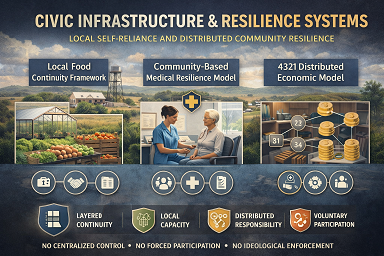
Structural Continuity Without Centralization
Civic Infrastructure & Resilience Systems focus on long-term structural stability across essential community functions.
Rather than operating services directly, this category houses architectural frameworks designed to strengthen continuity across food systems, economic participation, medical resilience, and essential infrastructure planning.
The emphasis is structural durability, not control.
These initiatives explore how communities can:
• Reduce single points of failure
• Build layered redundancy
• Strengthen distributed capacity
• Clarify structural boundaries
• Improve recovery under disruption
Participation is voluntary.
Adoption is local.
Authority remains decentralized.
Civic Infrastructure & Resilience Systems Structural Proposition Series
The core work within this category is now organized as a unified three-volume architectural series:
Civic Infrastructure & Resilience Systems Structural Proposition Series
This bundled series presents a layered approach to structural continuity across essential systems. Each volume is independently adoptable, legally bounded, sunset-disciplined, and designed to operate without centralized control.
Current volumes include:
Vol.I – Economic Stabilization Architecture (4-3-2-1 Model)
A structural participation and distribution model focused on reducing systemic fragility while preserving market incentives.
Vol.II – Food System Structural Durability Architecture
A resilience framework designed to reduce cascade risk, improve redundancy, and strengthen recovery capacity across food production and distribution systems.
Vol.III – Community Medical & Essential Service Continuity Architecture
A structural model focused on layered resilience in preventive coordination, distributed capacity, and continuity planning for essential community services while respecting licensed institutions and regulatory boundaries.
Together, these volumes form a coherent but modular structural continuity framework. Each may be studied or adopted independently.
Download the Current Series Bundle:
Civic Infrastructure & Resilience Systems
Structural Proposition Series
(Current Bundle)
Shared Structural Principles
All volumes within this series are guided by the following principles:
No centralized command authority
No forced participation
No ideological enforcement
No institutional replacement
Instead, they emphasize:
Clear structural design
Defined boundaries
Distributed responsibility
Transparent documentation
Incremental reinforcement
Reversibility and sunset discipline
Relationship to Other Program Categories
Civic Infrastructure & Resilience Systems operate at a structural level rather than a service level.
While Community Coordination & Mutual Aid programs focus on organizing tools, and Care & Welfare programs focus on direct support, this category addresses the architectural frameworks that allow those services to remain stable under stress.
These initiatives are architectural rather than operational.
Development & Adoption
All volumes within this series are structured frameworks and may exist in varying stages of refinement.
Communities are encouraged to:
Study the models
Adapt components locally
Test structural concepts
Provide feedback
Fork frameworks independently
Participation is voluntary.
Adoption is local.
Responsibility remains with each community.
Why This Category Exists
Communities often experience disruption not because of bad intent, but because of:
Single points of failure
Overconcentration
Unclear structural boundaries
Insufficient redundancy
Dependency without fallback
Civic Infrastructure & Resilience Systems exist to reduce structural fragility through thoughtful design and layered continuity planning.
Resilience is built before it is needed.