
Community Coordination Programs
Community Coordination Programs
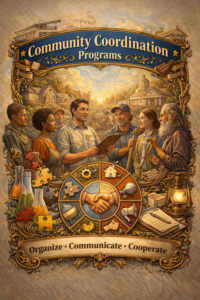
Community Coordination Programs
Community Coordination Programs exist to help people organize, cooperate, and take collective action at the local level without centralized control, hero leadership, or excessive bureaucracy.
These programs focus on structure, communication, and coordination, not ideology, entertainment, or authority. They are designed to support groups that want to work together responsibly while remaining locally autonomous.
This category exists to provide systems that help communities:
-
Coordinate effort without hierarchy
-
Share responsibility without centralization
-
Resolve conflict without escalation
-
Prevent fragmentation, burnout, or power concentration
Programs in This Category
Lodge-Based Community System:
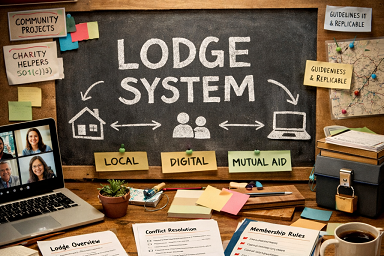
[ View Lodge System Overview ]
[ Download Lodge Documentation and Templates as Zip File ]
The Lodge system is a structured but flexible framework for local groups to meet, discuss, coordinate, and act together under shared principles while maintaining local autonomy.
Lodges may be:
-
Physical or digital
-
Temporary or long-term
-
Action-focused or discussion-focused
The system emphasizes:
-
No hero founders
-
No centralized leadership
-
Clear separation between charitable and civic activity
-
Defined mediation and conflict-resolution processes
This program serves as the primary coordination backbone for community-level organization.
Mutual Assistance Communal Living (Coordination Framework)
 [ Mutual Assistance Communal Living ]
This initiative provides a coordination framework for groups choosing to live communally or cooperatively, with an emphasis on shared responsibility, conflict mediation, and clear participation boundaries.
The focus is not housing construction or ownership, but how people coordinate daily life, share obligations, and resolve disputes without centralized authority.
This framework may be adapted independently or used alongside other community programs.
Essentials Lottery Program (Resource Coordination Model)
 [ Essentials Lottery Program ]
The Essentials Lottery Program is a structured coordination model designed to distribute essential resources fairly and transparently through participating businesses, donors, and community members.
While it involves material aid, its primary function is coordination, ensuring that:
-
Distribution rules are clear
-
Favoritism is minimized
-
Participation remains voluntary
-
No single entity controls outcomes
This program is listed here for its structural design rather than its charitable outputs.
Volunteer and Mutual Aid Coordination Tools
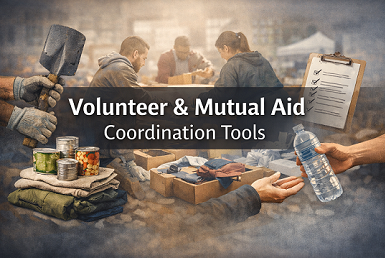
[ Volunteer and Mutual Aid Coordination Tools ]
Some communities require lightweight systems to coordinate volunteers, skills, tasks, or mutual aid efforts without formal employment structures or monetary exchange.
This initiative focuses on:
-
Task coordination
-
Skill sharing
-
Voluntary participation
-
Clear expectations without enforcement
These tools are intended to reduce confusion and burnout while preserving individual autonomy.
Remote Participation Room Documentation Kit (Pilot)
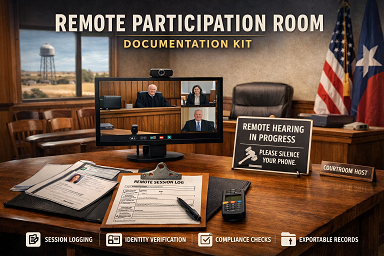
[ View Remote Participation Documentation Kit ]
[ Download RemoteCourtLog Flat-Pack v0.2 ]
This program provides a lightweight documentation framework for communities that host supervised remote participation sessions for public services, such as court hearings, at facilities like city halls or police stations.
The focus is not on replacing courts, case management systems, or official recordings.
The focus is coordination and documentation at the local facility level.
This kit helps facilities:
Document session metadata
Log identity verification procedures
Track room readiness and compliance checklists
Record incidents or disruptions
Archive structured session records without databases
The system is intentionally simple and flat-file based, allowing each session to be stored as its own self-contained folder that can be archived, transferred, or reviewed without specialized software.
The program does not:
Host video conferencing
Replace court authority
Modify judicial procedures
Act as a legal service provider
It exists as a coordination and documentation tool for facilities that wish to reduce geographic barriers while maintaining structured oversight.
The pilot version is designed for incremental improvement. Communities may deploy it locally, adapt it, fork it, or propose enhancements based on real-world needs.
Like all Community Coordination Programs, this initiative provides structure without hierarchy, tools without control, and templates without centralization.
What This Category Does Not Do
Community Coordination Programs do not:
-
Act as governing bodies
-
Replace local laws or institutions
-
Enforce ideology or political alignment
-
Require participation
-
Centralize authority or decision-making
They exist to support coordination, not to exercise control.
Responsibility and Separation
Each local group, lodge, or coordinated effort is responsible for its own actions, compliance, and outcomes.
Charity Helpers Foundation provides frameworks, templates, and guidance, not operational control or oversight, unless explicitly stated.
Programs may appear in multiple categories when they involve both coordination systems and direct services.
How Communities Can Use These Programs
Communities may:
-
Start a local lodge
-
Adapt coordination templates
-
Use documentation independently
-
Create parallel systems inspired by these models
Participation does not require formal affiliation unless explicitly stated.
Why This Category Exists
Many community efforts fail not because of bad intentions, but because of:
-
unclear roles
-
poor communication
-
unresolved conflict
-
lack of structure
Community Coordination Programs exist to reduce those failures by offering simple, reusable systems that communities can adopt, modify, or ignore as needed.