
Memorial & Legacy Programs
Memorial & Legacy Programs
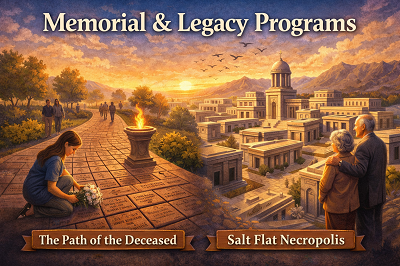
Our Memorial & Legacy Programs exist to honor life, preserve memory, and give families and communities meaningful ways to remember those who have passed. These programs are designed not as isolated gestures, but as parts of a larger, long-term legacy vision.
[ The Path of the Deceased ]
The Path of the Deceased is a memorial walkway concept built from engraved memorial bricks, each representing a person, a story, or a life remembered.
While families may participate by dedicating individual bricks, the Path itself is not merely a standalone feature. It is intentionally designed as a foundational element of a much larger memorial project.
Each brick serves two purposes:
-
A personal marker of remembrance
-
A structural contribution to a growing legacy space
In this way, individual memorials become part of something enduring, shared, and meaningful beyond a single name or moment.
Memorial Bricks and the Larger Vision
Memorial bricks are not an endpoint. They are building blocks.
Rather than scattering remembrance across disconnected sites, the brick program allows families to participate in the creation of a unified memorial environment that grows over time.
Each contribution helps shape a physical place where memory is preserved collectively, not forgotten individually.
[ The Salt Flat Necropolis ]
The Salt Flat Necropolis is a long-term legacy project inspired by ancient “City of the Dead” traditions found across human history, reimagined for the modern world.
For thousands of years, civilizations built intentional spaces to honor the dead:
-
Not hidden
-
Not rushed
-
Not forgotten
The Salt Flat Necropolis draws from this idea, proposing a modern, respectful memorial city designed for reflection, remembrance, and continuity.
This is not about morbidity.
It is about acknowledging death as part of life and giving memory a physical place to endure.
A Modern Approach to an Ancient Practice
The Salt Flat Necropolis concept is guided by several principles:
-
Respectful design
-
Clear separation from religion or politics
-
Long-term stewardship rather than short-term use
-
Public dignity without spectacle
It is meant to be quiet, intentional, and lasting.
A place where memory is allowed to remain, not be erased by time or development.
Why This Matters
Modern society often treats death as something to be hidden or hurried past. These programs take a different approach.
They recognize that:
-
Memory deserves space
-
Legacy deserves structure
-
Remembrance should outlast trends
The Path of the Deceased and the Salt Flat Necropolis together represent a forward-looking memorial model, one that respects both individual lives and collective history.