
Remote Participation Documentation Kit
Remote Participation Documentation Kit (Pilot)
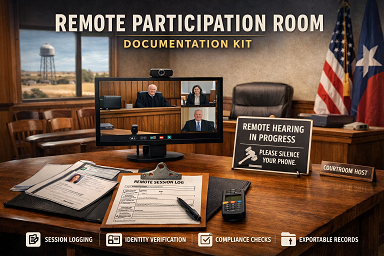
A Coordination Framework for Supervised Remote Public Participation
The Remote Participation Documentation Kit is a lightweight, flat-file documentation system designed for facilities that host supervised remote participation sessions for public services, such as court hearings.
This program does not replace courts.
It does not host video conferencing.
It does not modify judicial authority.
It exists to provide structured documentation at the facility level when a city hall, police station, or similar location is used to host a supervised remote session.
Why This Program Exists
In many rural communities, residents must travel long distances to attend short hearings or administrative appearances. When courts approve remote participation, facilities may provide a supervised room to allow residents to connect using the court’s approved video platform.
What often lacks structure is the local documentation process.
This kit exists to provide:
-
Clear session logging
-
Identity verification documentation
-
Room readiness checklists
-
Incident tracking
-
Exportable archival records
It supports coordination without centralizing authority.
What the Kit Does
The RemoteCourtLog Flat-Pack system included in this program allows a facility to:
Create a structured session record
Log participant identity verification steps
Document equipment and room readiness checks
Record incidents or disruptions
Store attachments such as consent forms
Export each session as a self-contained ZIP archive
Each session is stored as its own folder using human-readable JSON files. No database is required.
What This Kit Does Not Do
This program does not:
Host video conferencing
Replace court case management systems
Replace official court recordings
Provide legal advice
Act as a governing body
Alter judicial procedure
Video conferencing must be conducted using court-approved platforms such as Zoom Government, Teams Government, Webex Government, or state judiciary systems.
The documentation kit runs independently and locally.
Deployment Model
The system may be:
Installed on a single workstation in a remote participation room
Deployed on an internal LAN server for multiple rooms
Used completely offline except when launching the court-approved video session
It is designed to avoid cloud dependency, database infrastructure, or external API integrations.
Security and Risk Position
The system:
Uses flat-file storage
Requires no public internet exposure
Maintains an append-only audit log
Supports simple backup procedures
Relies on OS-level security controls
It is intentionally minimal to reduce attack surface and infrastructure complexity.
Pilot Status
This program is currently offered as a pilot framework.
Communities are encouraged to:
Deploy locally
Provide technical feedback
Suggest feature improvements
Fork or adapt the system independently
Future versions may expand features based on real-world requirements from clerks, IT departments, and judicial staff.
Who This Is For
This program may be useful for:
City halls hosting supervised remote hearings
Police stations providing secure remote access rooms
County annex buildings supporting rural access
Communities exploring structured remote participation models
It is intended as a coordination and documentation tool, not a replacement for institutional systems.
Downloads
RemoteCourtLog Flat-Pack v0.2
Installation & Technical Notes
Executive Summary
Technical FAQ
Security Considerations Appendix
Pilot Deployment Cover Letter
[ Download RemoteCourtLog Flat-Pack v0.2 ]
Responsibility and Separation
Each facility or local group remains responsible for:
Compliance with local law
Data retention policies
Court coordination
Operational procedures
Charity Helpers Foundation provides documentation frameworks and templates, not operational control.
Incremental Improvement
This program is designed for iterative development.
If a local court or IT department determines that additional features are required, the system may be updated or extended accordingly.
Structure evolves through use.